
The Core Model
Most people don't choose a communication style on purpose, they picked it up somewhere, and it takes over whenever a conversation gets tense. Naming the four patterns is the first step to catching yourself in the moment and choosing a better one.
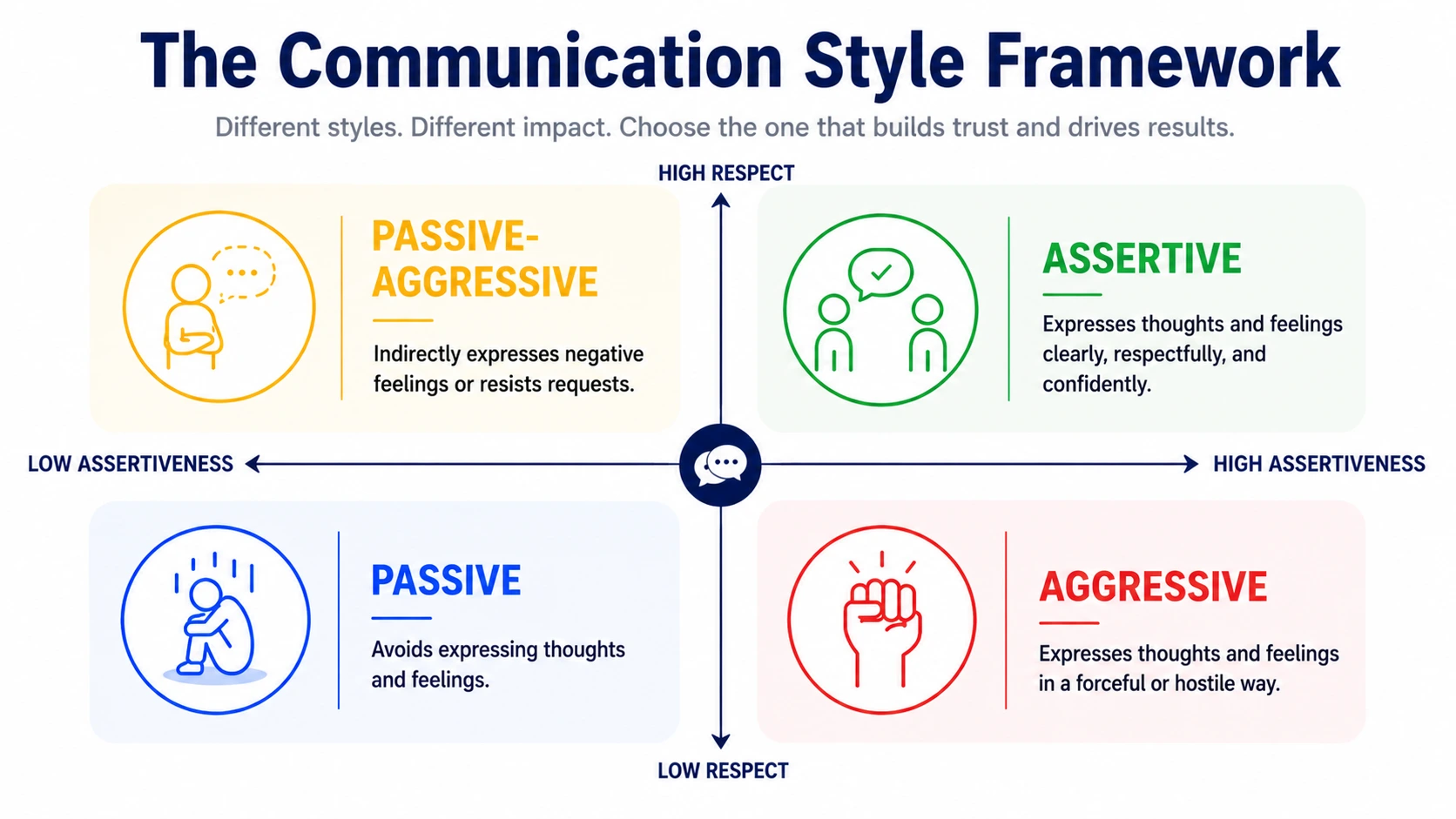
Passive: avoiding conflict by staying quiet or agreeing even when you don't, which means your own needs go unmet.
Aggressive: getting your point across by overpowering the other person, which damages the relationship and makes them less likely to speak up next time.
Passive-Aggressive: agreeing on the surface while resisting, delaying, or complaining behind the scenes, so the real disagreement never gets solved.
Assertive: saying what you think clearly and respectfully while still making room for the other person, the style the other three are all trying, and failing, to be.
Watch For
Agreeing out loud to something you don't actually agree with. The disagreement doesn't go away, it just goes underground.
Reinforce
Saying what you mean in plain words, without wrapping it in extra qualifiers or sarcasm.
Try This Week
Before your next pushback, write it in one plain sentence: what you want, no apology attached.
Why It Matters
Communication style isn't just a personality trait. It decides whether problems get caught early or pile up until they're expensive. Teams where people speak assertively catch misunderstandings sooner, run shorter meetings, and spend less energy dealing with things that were never said out loud. Passive and passive-aggressive styles feel safer in the moment, but they just move the friction to later, showing up as missed deadlines, quiet frustration, or a blow-up that seems to come out of nowhere.
On The Floor
A project lead disagrees with a timeline change during a planning call but says “yeah, that should be fine” to avoid friction. Two weeks later, the deadline slips, and frustration comes out in a sharp email instead of the original conversation. A coworker notices the pattern and asks directly, “what did you actually think when this got decided?” The lead admits the timeline never worked. The team fixes the plan right away, a week earlier than it would have come up otherwise.
Reflect
Think of a recent time you said yes when you meant no. What stopped you from being direct?
Which of the four styles, passive, aggressive, passive-aggressive, or assertive, do you default to under pressure?
Illustrative workplace case study
A composite learning example from the original issue, rather than a verified client result.
A composite example drawn from common workplace situations in HRDC Claimable communication workshops. A product team's weekly meetings ran long every week, with the same decisions getting revisited two or three times. On the surface, everyone seemed to agree quickly. The pattern traced back to two team members who rarely spoke up in the room. They nodded along during meetings, then raised concerns privately afterward, which meant decisions kept getting reopened once the meeting ended. The team lead named the pattern directly and asked both to raise concerns live, even half-formed ones, and promised nobody would be penalized for pushing back in the room. Meetings ran fifteen minutes shorter within two weeks, because disagreement came up once instead of twice.
Takeaways
Silent agreement in the room isn't real agreement, it just delays the real conversation.
Being assertive isn't about being louder, it's about saying the true thing once, clearly.
Making it safe to disagree in the room saves more time than it costs.