
The Core Model
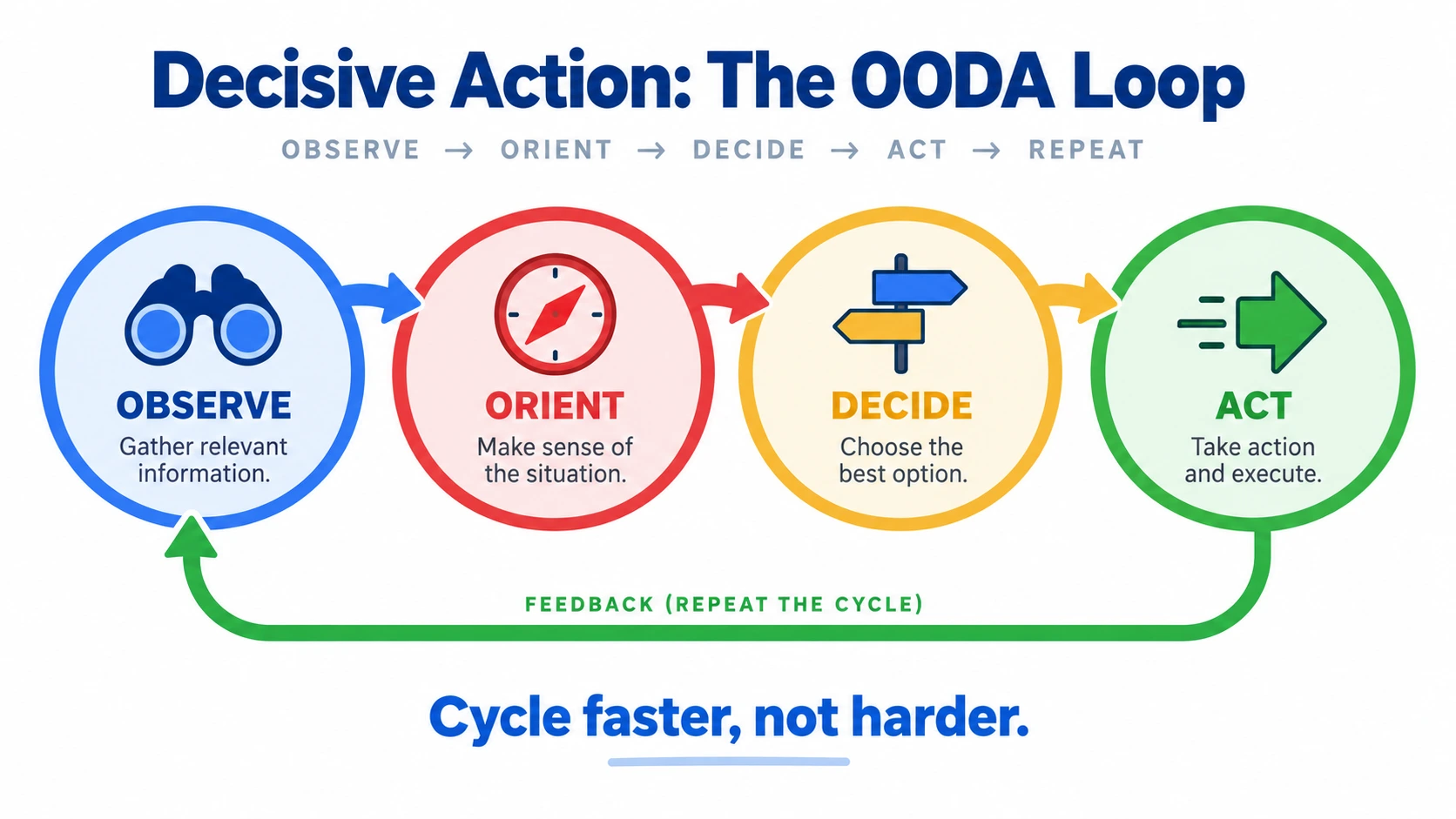
Military strategist John Boyd developed the OODA Loop to explain why the faster decider usually wins, even with less information. Business adopted it because it treats a decision as a cycle you keep running, not a single moment you have to get perfect.
Observe: gather what is actually happening right now, not what you assumed was happening last month.
Orient: filter what you see through context, experience, and your own bias. Boyd called this the step that decides the outcome, and it is the one most people skip.
Decide: commit to a course of action knowing your information will never be complete.
Act: carry it out, and watch closely what happens in response.
Loop: feed the result straight back into Observe. Speed comes from cycling quickly, not from thinking harder once.
Watch For
Collecting more information as a way of putting off the decision. Past a point, extra data buys comfort, not accuracy.
Reinforce
Saying out loud what would make you change your mind. It keeps the decision reviewable instead of personal.
Try This Week
Putting a deadline on one call that has been sitting. Decide by Friday with what you already have.
Why It Matters
Most costly decisions in an organisation are not wrong, they are late. A call that keeps getting deferred quietly commits everyone to the default option, which nobody chose and nobody owns. Teams that cycle quickly make smaller mistakes more often, and catch them before they compound. Teams that wait for certainty make fewer mistakes, but the ones they do make are bigger, because the ground has already shifted by the time they move.
On The Floor
A supplier misses a Monday delivery and the line will stall by Thursday. The manager does not call a meeting to review procurement policy. He checks what stock is actually on site (Observe), notes that this supplier has slipped twice already this quarter (Orient), splits the week's order across a backup vendor (Decide), and places it before lunch (Act). By Wednesday he knows the backup is holding, and he uses that to reopen the contract conversation from a much stronger position.
Reflect
Think of a decision you are currently sitting on. What information are you waiting for, and would it genuinely change your answer?
Under pressure, which step do you skip: observing what is really happening, or orienting before you jump to a solution?
Illustrative workplace case study
A composite learning example from the original issue, rather than a verified client result.
A composite example drawn from common workplace situations in HRDC-sponsored decision-making workshops. A manufacturing support team escalated nearly every non-routine issue to their department head. Turnaround averaged four days, and by the time approval came back down, the fix often no longer matched the problem it was meant to solve. The head did not hand out more authority all at once. She set one rule: anything reversible and under a set cost threshold gets decided by the person closest to it, same day, with a one-line note on what they saw and why they chose it. Anything irreversible still came to her. The notes turned out to matter more than the speed. Reading them each week, she could see where people's orientation was off, a wrong assumption about lead times in one case, an outdated cost figure in another, and correct it in a five-minute conversation rather than a new policy.
Takeaways
Separating reversible decisions from irreversible ones freed up the calendar without adding risk.
Writing down the reasoning made weak orientation visible, and therefore coachable.
Faster loops surfaced bad assumptions early, while they were still cheap to fix.