
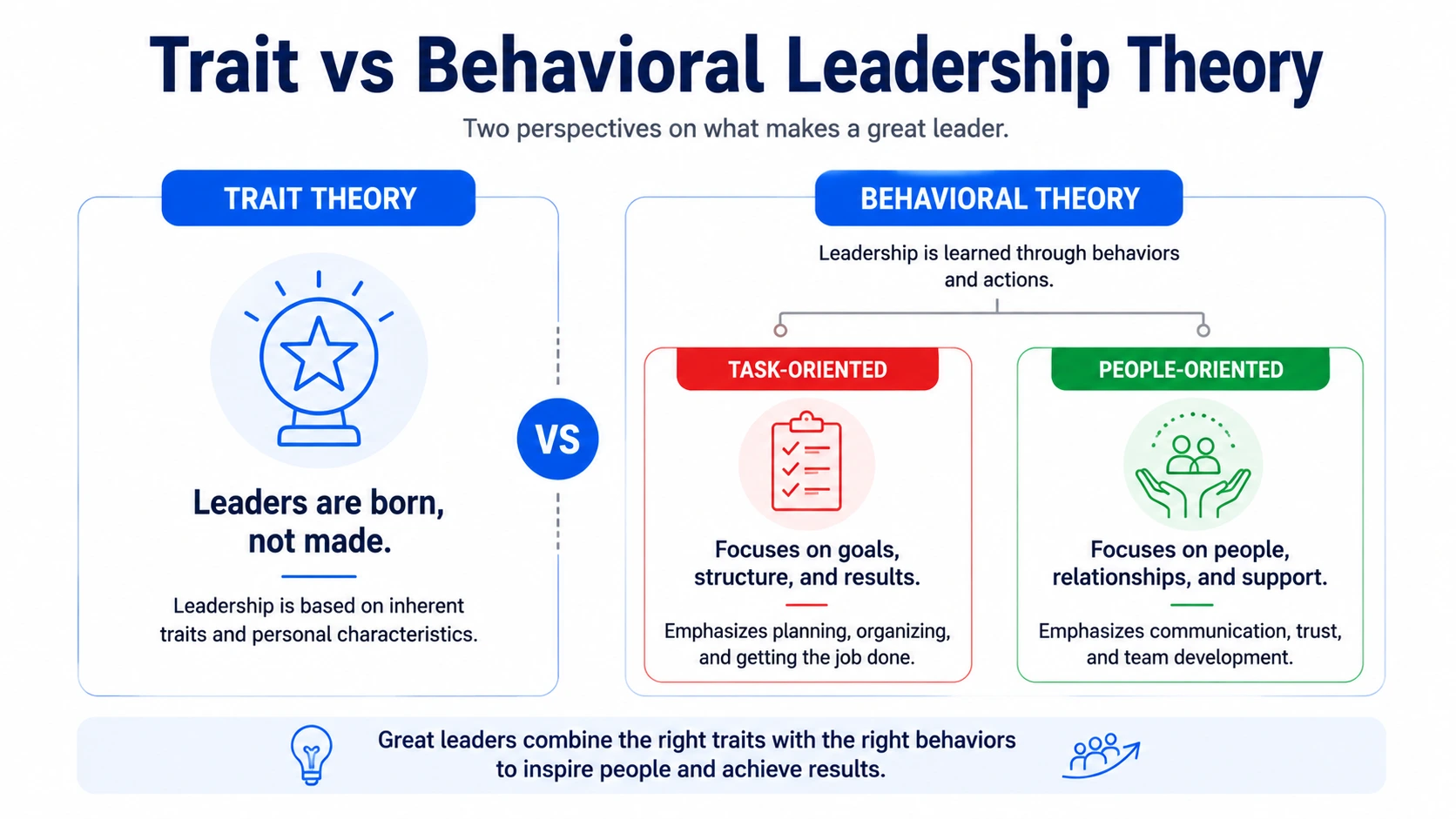
The Core Model
Early leadership research split into two answers. Trait theory looked for the fixed qualities that make someone a leader. Behavioral theory looked at what leaders actually do, and found something more useful: behavior can be learned.
Trait Theory: the old idea that leaders are born with fixed qualities, like confidence or charisma, so leadership potential can be spotted early but not really taught.
Behavioral Theory: the idea that leadership is a set of actions, like delegating, communicating clearly, and setting expectations, that anyone can learn no matter their personality.
Task-Oriented Behaviors: actions focused on structure, deadlines, and getting the work done well.
People-Oriented Behaviors: actions focused on relationships, morale, and making people feel heard.
The Modern View: most good leaders use both, but behavior is the part you can actually control, which is why it’s worth practicing.
Watch For
Believing you either “have it” or you don’t. That belief quietly lets you off the hook from practicing the behaviors that build trust.
Reinforce
Being consistent, not flashy. A leader who follows through on small promises earns more trust than one who gives a great speech.
Try This Week
Pick one task-focused and one people-focused behavior to practice this week, not just when it’s easy.
Why It Matters
Treating leadership as something you're born with quietly limits who gets a chance to grow into it. Companies that teach leadership as a set of behaviors build stronger, more consistent leaders at every level, not just among the naturally outgoing few. It also changes how people see their own gaps: a skill you haven't learned yet is something you can work on. A trait you don't have feels like something you're stuck with.
On The Floor
A quiet, detail-focused analyst gets asked to lead a cross-team project and privately assumes she isn't “the leader type.” Instead of trying to act louder, she focuses on two things: setting clear weekly expectations and checking in with each person one-on-one. Three months later, her project has the fewest missed deadlines in the department, and two teammates ask to work with her again, not because she changed who she is, but because of what she kept doing.
Reflect
Do you lean more on natural traits or practiced behaviors right now? What would shifting that look like?
Name one task-focused and one people-focused behavior you already do well without thinking about it.
Illustrative workplace case study
A composite learning example from the original issue, rather than a verified client result.
A composite example drawn from common workplace situations in HRDC Claimable leadership workshops. A warehouse team promoted its most skilled worker into a shift lead role, expecting his skill on the floor to naturally carry over into leading people. It didn't. He knew the equipment better than anyone, but shifts felt chaotic, handoffs got missed, and the team wasn't sure who was in charge. Nobody had taught him that leading takes different skills than doing the work well yourself. A short coaching plan focused on two habits, giving clear briefings at the start of each shift and a two-minute handoff summary at the end, fixed the pattern within a month. Missed handoffs dropped a lot, and the team started calling him “on top of things,” not because his technical skill changed, but because his behavior did.
Takeaways
Being good at the work and being good at leading people are two different skills.
Behavior can be coached, even when confidence can't be forced.
Small, steady actions build more trust than one strong first impression.