
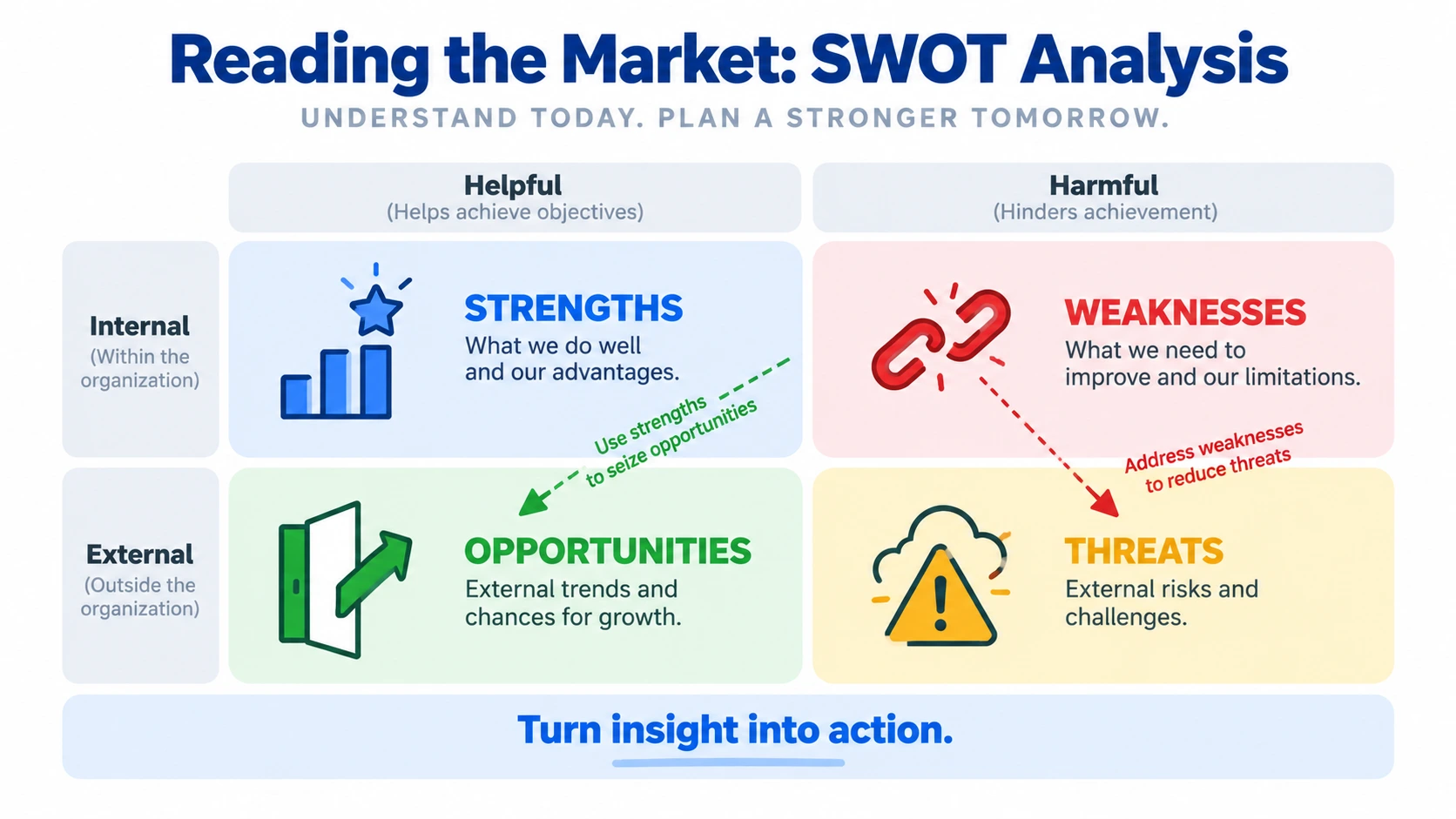
The Core Model
SWOT came out of strategy research in the 1960s and has outlasted far fancier frameworks because it does one useful thing: it separates what you control from what you do not, before anyone starts making plans.
Strengths: what you genuinely do well inside the organisation, stated plainly enough that a competitor would agree with you.
Weaknesses: internal gaps that slow you down, including the ones everyone knows about but nobody writes down.
Opportunities: outside shifts you could move on (a change in the market, new regulation, a technology, a competitor's stumble).
Threats: outside shifts that could hurt you whether or not you do anything about them.
Pair them: the grid only pays off when you match items across the boxes: using a strength to take an opportunity, or closing a weakness that a threat would expose.
Watch For
Four tidy lists that lead nowhere. A SWOT that stops at the grid is a meeting, not a strategy.
Reinforce
Keeping internal and external items in their own boxes. A competitor's move is not your weakness.
Try This Week
Writing one honest weakness your team would name but rarely says aloud, then the threat it exposes.
Why It Matters
Teams rarely disagree about the facts, they disagree about which facts matter. A SWOT puts that disagreement somewhere visible, on one page, where it can be settled instead of carried around from meeting to meeting. It also guards against two expensive errors: treating an outside threat as somebody's personal failure, and treating an internal weakness as bad luck. Being clear about which is which changes who owns the fix, and how quickly it gets done.
On The Floor
A branch manager notices sales have been flat for two quarters. Rather than calling it a motivation problem, she spends twenty minutes at a whiteboard with her supervisors and fills in four boxes. Strengths: the fastest turnaround in the region. Weaknesses: nobody is trained on the new product line. Opportunities: a competitor has just closed two outlets nearby. Threats: their own lease is up for renegotiation in eight months. Written down, the plan more or less chooses itself: train the team now, while the competitor's customers are still looking for somewhere to go.
Reflect
If you had to write down one weakness your team knows about but never raises in a meeting, what would it be?
Which of your current problems is genuinely external, and which have you been treating as external because that is more comfortable?
Illustrative workplace case study
A composite learning example from the original issue, rather than a verified client result.
A composite example drawn from common workplace situations in HRDC-sponsored strategy and business acumen workshops. A mid-sized services firm ran a SWOT every January. The grid went into the annual plan, the plan went into a shared folder, and by March nobody on the leadership team could name a single item on it. The change they made was small. They cut the exercise to one page, capped each box at three items, and added a line at the bottom: the one pairing they would act on that quarter. Everything else stayed on the list but came off the agenda. Narrowing it made review possible. Each quarter the team could say plainly whether that one pairing had moved, and the boxes that carried weight stopped being the ones with the longest lists.
Takeaways
The shorter SWOT actually got used. The comprehensive one got filed.
Forcing one pairing per quarter turned the analysis into a decision.
Reviewing quarterly caught outside shifts while there was still time to respond.